By Jasmine Cole, founder of CozyCross ·
How Many Strands of Floss for Cross Stitch? By Fabric Count
Every skein of embroidery floss is six fine strands twisted loosely together, and almost no cross stitch chart wants all six at once. That one fact explains most of the questions I get about thread: why a 14CT kit card mentions two strands, why the same design looks padded on one fabric and airy on another, and why a friend's advice for her 11 count sampler made your 18 count project look like rope.
This guide answers the strand question count by count, for full crosses and for backstitch, then gives you a ten-minute test that settles any doubt on your own fabric. Two neighboring topics already have their own pages: the finished size of a design at each count is worked out on our home page, and the all-six-strands habit is item two of the beginner cross stitch mistakes guide. Here we only talk about how many strands go through the needle.
Why Strand Count Follows Fabric Count
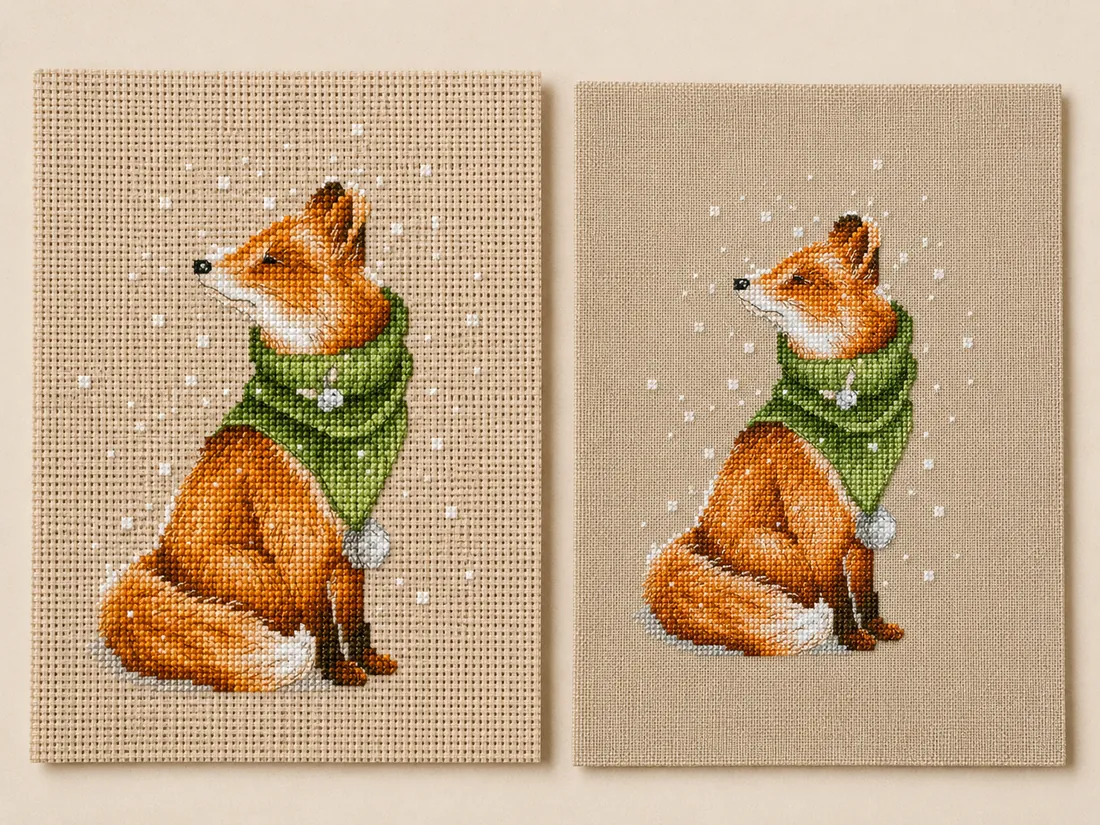
Put a ruler on the fabric and the logic is visible. One square on 11 count aida measures about 2.3 mm across, on 14 count about 1.8 mm, on 16 count about 1.6 mm and on 18 count about 1.4 mm. Those figures come from the fabric count table in my beginner's guide to cross stitch, and they are the whole story: a cross made of three strands sits comfortably in a 2.3 mm square and would bulge out of a 1.4 mm one.
The strands themselves never change: a single strand of cotton floss is the same thickness on a stocking or a coaster. What changes is how many of them share the square. Fewer strands than the square needs and the weave shows through as a fine grid; more than it needs and the crosses pile up, pull the holes open and refuse to lie flat. The numbers below are the common practice printed on most charts; the test in the last section makes them yours.
The Strand Chart: 11, 14, 16 and 18 Count
| Fabric count | One square | Full cross (common practice) | Backstitch | The look you get |
|---|---|---|---|---|
| 11 count aida | about 2.3 mm | 3 strands | 1 strand, 2 for bold lines | Big, plush crosses that hide the weave; the easiest fabric to see |
| 14 count aida | about 1.8 mm | 2 strands, 3 for fuller coverage | 1 strand | The kit standard: crisp at two, solid at three |
| 16 count aida | about 1.6 mm | 2 strands | 1 strand | Denser and smoother than 14, with the same two-strand needle |
| 18 count aida | about 1.4 mm | 2 strands, 1 for a delicate finish | 1 strand | Small, precise crosses; one strand reads almost like a drawing |
Notice that 14, 16 and 18 count share the same two-strand default, so a stitcher who learns on 14CT moves up to 18CT without relearning her thread.
Every row of that table exists in the CozyCross range. Our stamped cross stitch kits come on 11CT or 14CT; the Little Animals, Black Canvas florals and Night Songs birds in our counted cross stitch kits come on 14CT or 18CT; and the Christmas stocking kit is printed on 14CT or 16CT, with an unprinted 11CT or 14CT option.
Coverage: What a Full Cross Looks Like
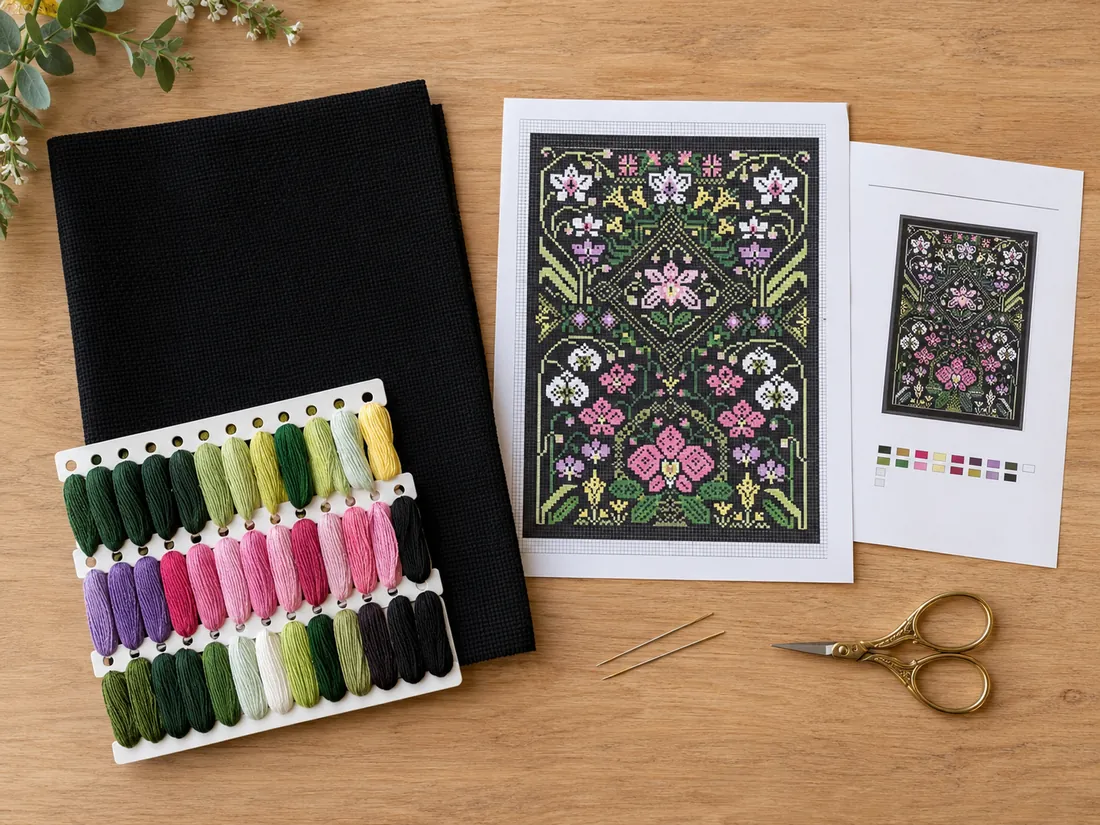
Coverage is the word stitchers use for how completely the floss hides the fabric. Three habits improve it more than an extra strand does. Separate all six strands one at a time and put two back together, so they lie side by side instead of twisting as one cord. Let the needle dangle every dozen stitches so the thread untwists. And keep tension gentle: a cross pulled tight goes thin whatever its strand count.
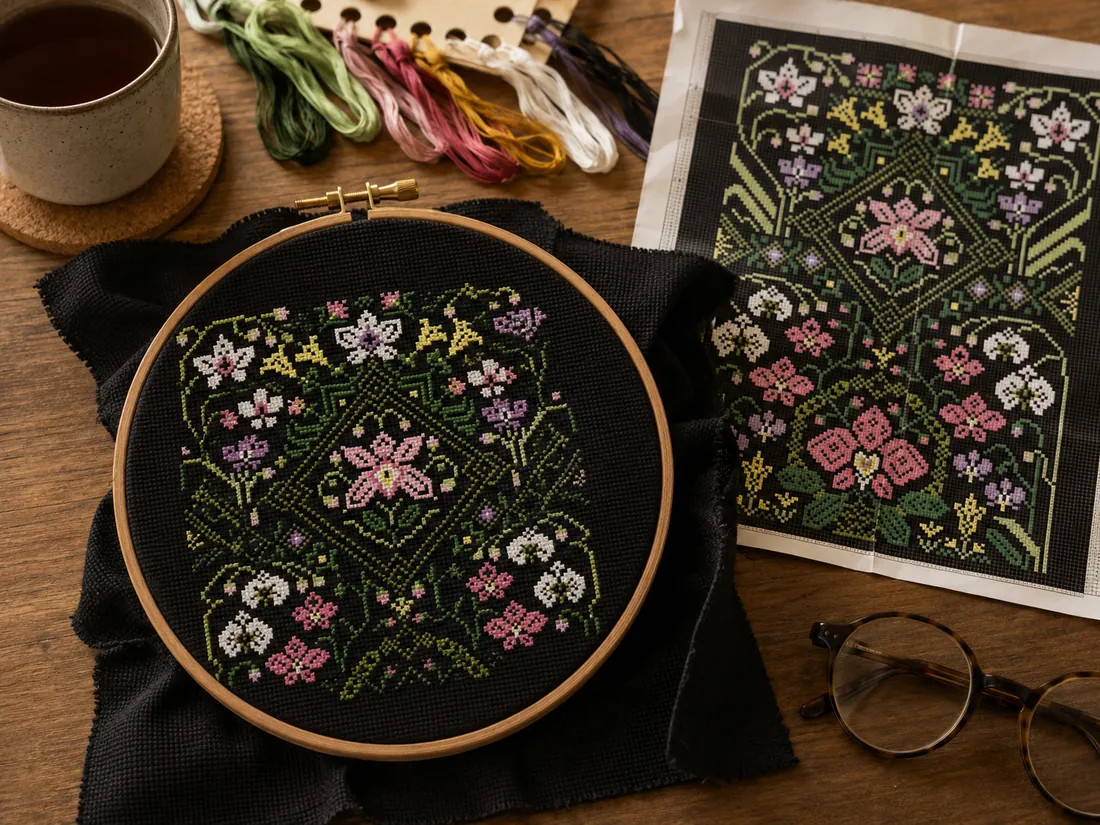
Dark fabric changes the calculation. On the black aida of our Black Canvas florals and Night Songs birds, light floss has to cover a background that shows through every gap, and many stitchers move from two strands to three on 14CT for that reason alone; two looks lovely on black, three reads more solid from across the room.
Stamped fabric follows the same strand counts as blank fabric: three on 11CT, two on 14CT. The printed guide tells you where each cross goes; the fabric count still tells you how many strands go into it.
Backstitch, French Knots and Fractional Stitches
Backstitch sits on top of finished crosses, so it is judged by how sharp the line looks, not by coverage. One strand draws a fine outline that lets the crosses keep their texture; two draw a bolder line that reads from a distance, which is why charts often specify two for lettering, faces and any outline that carries the design. My guide to reading a cross stitch pattern shows how the legend marks these lines.
French knots, the dots that give birds their eyes and flowers their centers, are one place where fewer strands and more wraps beat more strands and fewer wraps: the knot stays round instead of lumpy. Quarter and three-quarter stitches continue the cross they belong to, so they take the same strands as the full crosses.
In practice most projects run two needles at once, a two-strand needle for the crosses and a one-strand needle waiting for the outlines, which is exactly the pair our Night Songs bird kits include.
When the Chart or Kit Card Says Something Else
Kit cards carry the same information in shorter form: the label on the Children's Paradise stocking reads 37 x 53 cm with 2 strands for its 16CT fabric, the 16 count row of the table. When a kit offers a choice of counts at checkout, as our counted kits do between 14CT and 18CT, the strand count for full crosses stays at two on both; only the finished size changes, and that conversion is laid out on the home page.
One more case where the fabric overrides the chart: if you stitch a chart written for 14 count on 18 count for a smaller finished piece, drop to the 18 count row rather than keeping the chart's number. The design was drawn in squares, and the squares just got smaller.
Changing Strands on Purpose: Texture and Floss Use
Once you know the default, changing it becomes a design tool: three strands on 14 count give a quilted, almost woven texture that suits samplers and folk motifs, two strands on 11 count a deliberately airy piece where the fabric is part of the picture. The one rule is consistency, because a block at two strands beside a block at three shows as a patch that no washing or pressing will hide.
Floss math: a standard 8.7-yard skein yields about seventeen 18-inch working lengths of six strands: 51 needlefuls split for two-strand stitching, 34 split for three. Going up a strand costs half again as much floss on every color, which is why the decision belongs at the start of the project, not halfway through the background.
Our kits are sorted with that decision in mind: the floss arrives on labeled organizers keyed to the chart legend, so you can see at a glance how much of each color you hold. The Little Animals kit, nine small motifs in one box, is the one I suggest for experiments: one animal at two strands and its neighbor at three teaches more about coverage than any table.
The Ten-Minute Coverage Test
Use the outer margin of the fabric, the part that ends up under the frame, and stitch a full ten by ten block of one color: a single cross always looks thin and a lone row looks striped, and only a filled block shows what the finished surface will be.
Look at the block three ways: under a lamp at arm's length, which is how the framed piece will be seen; close up, to check that the holes around each stitch have kept their shape; and in the chart's palest color if you can, since pale floss on dark fabric shows gaps first. Ten minutes later you have an answer no table can give, because it was measured on your fabric with your tension.
If the block passes, leave it in place; it becomes the reference you match your tension to after a two-week gap. If you would rather skip the test, take 14CT with two strands, the pairing most guides on this site are written for, including the cross stitch kits for beginners page.
knitters took part in the survey linking more frequent needlecraft to feeling calm and happy
— Riley et al., British Journal of Occupational Therapy, 2013
Strand Count FAQ
How many strands of floss for 14 count aida?
Two strands is the common choice on 14 count aida and what most kit charts list. Three gives fuller coverage, which many stitchers prefer on dark fabric or for a padded, sampler-style surface.
How many strands of floss for 11 count aida?
Three strands. The squares on 11 count measure about 2.3 mm, the largest of the common aida counts, and two strands leave the weave visible as a grid most people find too open. Three fills the square and hides the fabric.
How many strands for backstitch?
One strand for most outlines, two when the chart wants lettering, faces or a main outline to stand out. Backstitch goes on after the crosses in that area are complete, whatever the strand count.
Can I cross stitch with all six strands?
Six strands make bulky, ropey crosses that distort the fabric and pull the holes open. Separate the strands one at a time and recombine only the number your fabric count needs, usually two or three. It is number two on our list of beginner cross stitch mistakes.