By Jasmine Cole, founder of CozyCross ·
Small Cross Stitch Patterns You Can Finish in a Weekend
Two free days, a chair by a window, and the wish to put something finished on the shelf by Sunday night. It is the most common thing people write to us about, and the hardest to answer with a catalog, because "small" on a pattern label means very little: a design listed at five inches can hold more stitches than one listed at ten.
What follows is the four things that decide how long a chart takes, and how to turn them into your own hours. After that, sorting patterns into a weekend, a week or a winter is arithmetic.
The Four Things That Make a Pattern Fast
Difficulty is not on the list. A weekend design and a season-long design are made of the same X over the same grid; what separates them is quantity, not skill.
| Lever | What it means | How to read it fast |
|---|---|---|
| Stitch count | The number of squares the design occupies | Count the 10 by 10 blocks across and down the chart |
| Coverage | The share of that rectangle carrying stitches | Look at the sample photo: how much fabric stays bare? |
| Color count | How many shades the legend lists | Count the rows in the floss legend |
| Thread changes | How scattered each color is across the design | Scattered confetti symbols cost more than solid blocks |
Stitch Count Is the Real Size
Inches mislead. A pattern advertised in centimeters tells you how much wall it will fill, not how much stitching it contains: the same design printed for a finer fabric shrinks while every stitch stays where it was. Two patterns can share a listed size and differ threefold in stitches.
The grid settles it. Those heavier lines every ten squares double as a ruler: six blocks wide by nine tall is 60 by 90 squares, an envelope of 5,400. If the whole chart fits inside a ten by ten arrangement of blocks, it is a genuinely small pattern whatever the label says. Our guide on how to read a cross stitch pattern walks through the grid, the center arrows and the legend in the order you meet them.
Why a Big Rectangle Can Be a Small Job
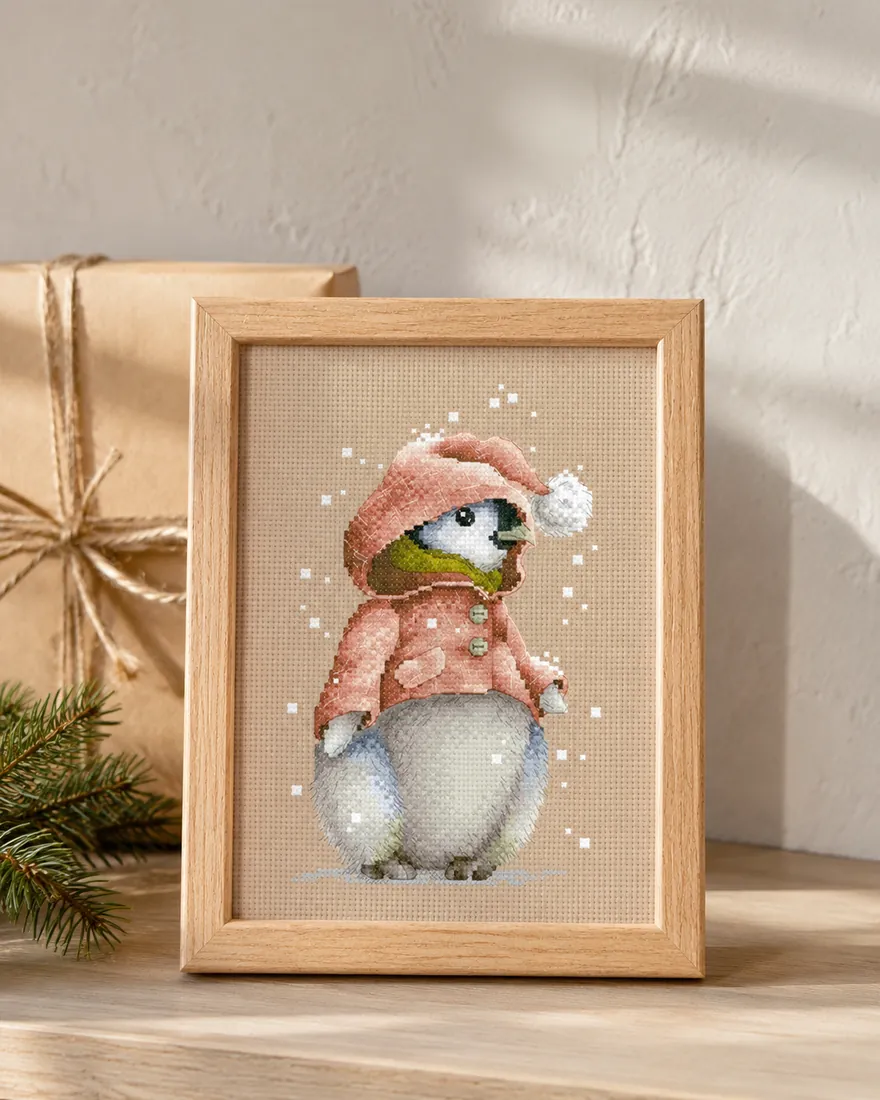
One glance at the sample photograph settles it. A small animal in falling snow on warm flaxen fabric occupies a modest island in the middle of its rectangle: the animal, its scarf, a scatter of snowflakes, then bare cloth to the edges. Nobody stitches that background, because it is already the right color, which is why flaxen, sky blue and black keep recurring.
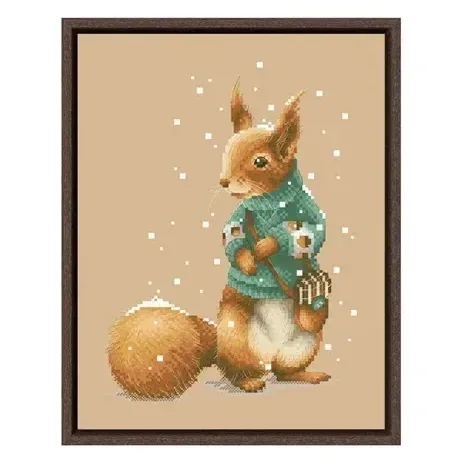
A shortcut: estimate what fraction of the printed area carries symbols. Half is generous for a motif, a quarter is common. Multiply the envelope by that fraction and the estimate becomes useful.
Color Count and the Cost of a Thread Change
Count the rows in the floss legend and you have the number, printed on every counted chart. Silhouettes and line motifs sit at the low end; photorealistic shading of fur, water or sky sits at the high end.
Distribution is the other half. Twelve colors in solid blocks work up faster than eight sprinkled as single stitches, the kind stitchers call confetti. Solid blocks let you settle in; confetti sends you back to the legend.
Sorting removes a slice of that overhead. In every CozyCross kit the threads arrive pre-sorted on numbered cards keyed to the legend, the detail buyers mention most often in our customer reviews. Two or three strands on 14-count is usual, and stitching with all six is one of the classic beginner cross stitch mistakes.
of US households took part in at least one creative activity in the past 12 months, which is the company you are in when you pick up a needle
Fabric Count Changes the Picture, Not the Work
This trips up almost everyone. Our black-canvas floral designs finish around 10 by 13.5 inches on 14-count and around 8.5 by 11 inches on 18-count: same chart, same stitches, a picture roughly a fifth smaller each way. Picking 18CT to save time does the opposite of what people expect.
What the count really changes is comfort. On 14-count the squares are large enough to see without strain, which is why nearly every tutorial assumes it and why we default beginners to it. On 18-count the stitches are physically smaller, so most stitchers place them more slowly and want better light. Counts and strands are covered in how to cross stitch.
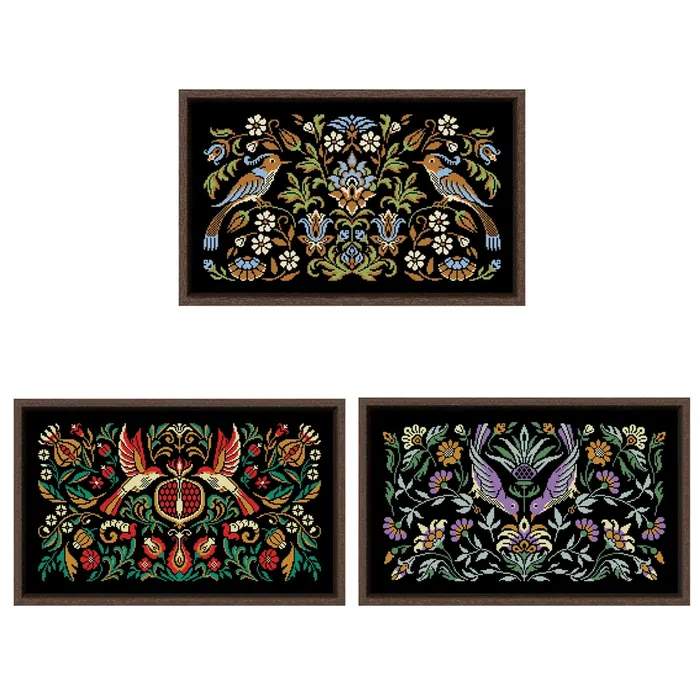
The three bird tableaus above are the other end of the scale: wide panels, dense foliage, borders edge to edge.
Find Your Own Stitching Rate in Ten Minutes
The method is crude, and that is the point. Pick a block near the middle with a normal mix of colors and stitch it completely, timing yourself. One hundred squares divided by the minutes taken gives your rate per minute; multiply by 60.
Then run the whole design: envelope in stitches, times your coverage estimate, divided by your rate. A weekend of relaxed stitching and two weeks of half an hour a night often come to the same total, which is why one person calls a motif a weekend project and another calls it a fortnight. Your rate also rises steeply at the start, and washing and pressing need time no chart accounts for.
For a fixed date the arithmetic runs backwards. Our Christmas stocking kits publish a range of roughly 60 to 100 hours for a densely covered design, turned into weeks-until-December.
Small Patterns, Sorted by Sittings
One sitting: the single-color silhouette. An outline, a small bird, a heart, a tiny house, worked in one shade. One thread, no legend, no changes. The fastest thing in the craft.
One or two sittings: the counted alphabet or monogram. Letters are straight runs that repeat their shapes, so your rate climbs fast, and two or three of them inside a simple border stay small.
A weekend: the small animal or object motif on an open ground. A compact subject, a modest palette, and unstitched fabric doing the work of a background. It teaches chart reading, color changes and finishing.
A weekend in strips: the geometric border or bookmark band. Long, narrow and endlessly divisible. You learn the repeating unit once, and the shape makes stopping mid-row easy.
Two or three sittings: the seasonal ornament. Small by design, since it has to fit a hanging shape, and usually built from a short, bright palette.
Several sittings: the small floral spray. Larger palettes for the shading, but compact shapes and plenty of bare rectangle. The step up is color count, not size. Whether the chart arrives blank or printed changes the reading, not the arithmetic: that tradeoff is in stamped vs counted cross stitch.
studies in a scoping review found needlecraft has an overwhelmingly positive effect on mental health and wellbeing
Where the Short Projects Live in Our Range
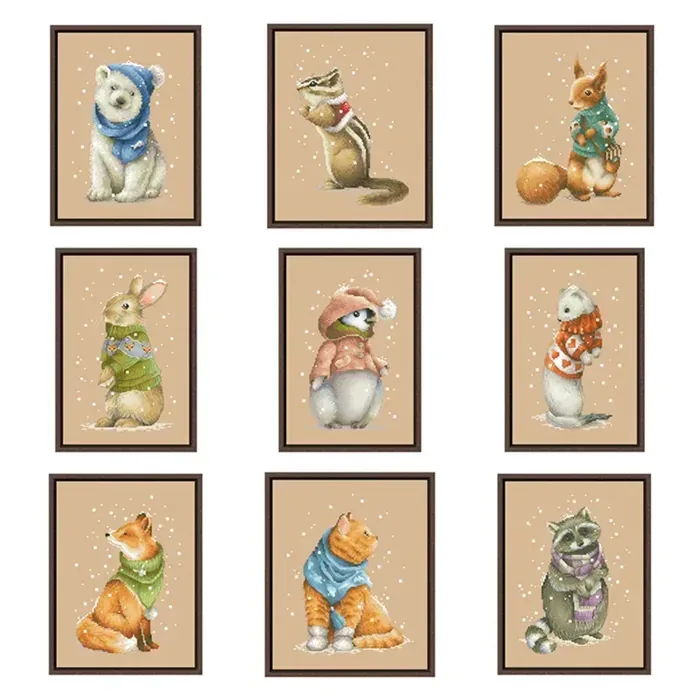
Nine designs in one box matters for weekend stitching: the second motif starts the moment the first is framed, on fabric and threads you already understand, at a rate that has climbed.
The rest of the range sorts itself once you know the levers: the bird samplers and black-canvas florals are multi-session pieces with fuller palettes, the printed stockings the season-long heirlooms. They sit side by side on our counted cross stitch kits page, and the shortest starting points on cross stitch kits for beginners.
Our line, plainly stated: 7 kits, 49 designs, on flaxen, white, sky blue and black Aida in 11CT to 18CT depending on the kit, from $24.95 to $39.95. Free shipping, dispatch in 1 to 2 business days, delivery in 6 to 10 business days, and a 30 day money back guarantee.
Small Cross Stitch Pattern FAQ
What counts as a small cross stitch pattern?
Size is measured in stitches, not inches. A chart that fits inside roughly ten by ten blocks of the printed grid is a small pattern, because each block is 100 squares.
How do I work out how long a pattern will take me?
Time yourself over one full 10 by 10 block. That is 100 stitches, so it converts straight into stitches per hour. Estimate the stitches in the whole design and divide by your rate.
Does 18 count fabric make a pattern quicker than 14 count?
No. The same chart has the same number of stitches on every count; only the finished piece changes size. 18CT packs them into a smaller area, so the picture shrinks while the workload stays identical. We suggest 14CT while you build speed.
Do fewer colors really make a pattern faster?
Yes, because every color is a start, an end and a rethreaded needle. A motif using a handful of shades spends most of its time stitching; a design using dozens spends part of the session changing thread.